
The West Bengal government will resume the rural employment scheme under the Viksit Bharat-Guarantee for Rozgar and Ajeevika Mission (Grameen) Act in all districts of the state, barring Murshidabad and South 24 Parganas, where allegations of irregularities in its implementation are being investigated.

The Centre has announced that the Viksit Bharat -- Guarantee for Rozgar and Ajeevika Mission (Gramin) Act will come into force across the country from July 1, replacing the Mahatma Gandhi National Rural Employment Guarantee Act.

The government on Friday renamed its flagship rural job guarantee programme - National Rural Employment Guarantee Act (NREGA) - after Mahatma Gandhi.

The Indian government has announced the replacement of the Mahatma Gandhi National Rural Employment Guarantee Act (MGNREGA) with the Viksit Bharat Guarantee for Rozgar and Ajeevika Mission (Gramin), or VB-G RAM G Act, 2025, effective July 1. The new scheme aims to expand guaranteed wage employment and link it more closely with infrastructure development and climate resilience, but faces concerns from opposition parties and labour rights activists.
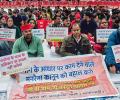
The Centre has notified draft rules for the Viksit Bharat - Guarantee for Rozgar and Ajeevika Mission (Gramin) Act, 2025, outlining the framework for the new rural employment programme replacing MGNREGA. The draft rules are open for public feedback until June 21, 2026.

'MGNREGA was about a guaranteed right to work.' 'The new law does not guarantee employment at all.' 'It removes everything that made MGNREGA a legal guarantee.'

UPCC chief Ajai Rai clarifies Priyanka Gandhi Vadra's role in Uttar Pradesh Congress campaigns, emphasizing her national leadership while confirming her continued prominence in the state.

The appeal was made by rural development ministry secretary B K Sinha to industries and corporates to collaborate with the ministry in its wage employment programme Mahatma Gandhi National Rural Employment Guarantee Act and self-employment programme Swarnajayanti Gram Swarojgar Yojna.

The total expenditure on the MGNREGA programme, as per the revised estimates from 2025-26, was Rs 88,000 crore, while initially, a sum of Rs 86,000 crore was allocated.

After a gap of more than three years, the central government has agreed to resume the Mahatma Gandhi National Rural Employment Guarantee Act (MGNREGA) works in West Bengal with immediate effect, but subject to mandatory adherence to stringent conditions. These include a prohibition on any work valued at more than 20 lakh, compulsory 100 per cent electronic know-your-customer (eKYC) verification of all workers, and mandatory pre-estimation field visits for all works before they are undertaken.

The successful implementation of the Mahatma Gandhi National Rural Employment Guarantee Act in parts of West Bengal has meant that fewer hands are available today to craft mud and straw into the idols that are central to goddess Durga's homecoming every autumn.

'A work guarantee that can be switched off at will is no guarantee at all.'
We need real laws to protect whistle-blowers, and even more than that real action should be taken against perpetrators, says Sandip Sukhtankar.

This comes a day after President Droupadi Murmu gave her assent to the Viksit Bharat Guarantee for Rozgar and Ajeevika Mission (Gramin) (VB-G RAM G) Bill, which replaces the MGNREGA and has a provision for 125 days of wage employment for rural workers.
New Rural Development Minister Jairam Ramesh has, however, taken up the challenge on how to synchronise the employment guarantee programme with the ground realities.
Nearing the four crore (40 million) mark in providing jobs under MGNREGA, re-launching the Provision of Urban Amenities in Rural Areas scheme and reinforcing social audit in programmes on complaints of irregularities were the foremost tasks of the rural development ministry in 2010.

The Rural Development Ministry has been allocated Rs 1.88 lakh crore in the Union Budget for 2025-26, around 5.75 per cent more than the allocation in the previous budget.
Government managers are asking for a 60 per cent rise in allocation for the scheme in the next financial year. Rs 20,854 crore (Rs 208.54 billion) had been spent on the scheme until December 2010. Rs 64,000 crore (Rs 640 billion) has been sought for the coming financial year.

The Centre has allocated Rs 73,000 crore to the rural employment guarantee programme Mahatma Gandhi National Rural Employment Guarantee Act for the next fiscal 2021-22, substantially lower than the actual expenditure of Rs 1.11 lakh crore in the current fiscal which included an additional Rs 40,000 crore for the scheme given by the government in the wake of the pandemic's impact on the economy.

A district-level investigation has named several individuals, including relatives of India cricketer Mohammed Shami.
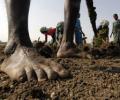
Member of Parliament can now allocate funds from their local area development scheme kitty for rural employment guarantee programmes. The move that comes just ahead of Budget is aimed at providing the much-needed fiscal cushion to operate the UPA's most ambitious social security programme, the Mahatma Gandhi National Rural Employment Guarantee Act (MNREGA).

Non-flagship programmes to get a mere 5% hike in allocation
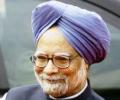
'MGNREGA Sameeksha' is an anthology of all major research studies on performance of the programme that were published in academic journals or the stand-alone reports, but excluding the newspaper and magazine articles and opinion pieces, says Rural Development Minister Jairam Ramesh in his forward to the volume.


Karnataka Governor Thaawarchand Gehlot has refused to address the joint sitting of the state legislature, prompting government intervention. The reasons are unclear, but follow similar incidents in other states.
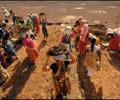
Pawar said the Union Cabinet has already decided last week to reschedule crop loans of farmers in the affected drought areas with reduced interest rate of 7 per cent.

Three laws passed in Parliament could boost central revenues, reshape GST cess flows, shift MGNREGA costs to states and create new budget headroom ahead of the 2026-2027 Union Budget, points out A K Bhattacharya.
China has sought information on India's poverty reduction programmes, including the Mahatma Gandhi National Rural Employment Guarantee Scheme, to beef up its own strategy.
With the threat of a failed monsoon and an impending drought, the need for public works and for greater numbers of workers will arise in many states, says Aruna Roy
The Centre has allocated Rs 73,000 crore for the rural jobs guarantee programme for 2022-23.

Patil in her address to both Houses of Parliament said higher public spending on programmes of rural development has successfully raised incomes in those areas.
Union Minister of State for Communications and Technology Sachin Pilot on Friday charged the National Democratic Alliance government in Bihar with misuse of central funds worth over Rs 11 crore under Mahatma Gandhi National Rural Employment Guarantee Act and other flagship programmes for the poor.

Programme has also failed in its target of providing a guaranteed employment of 100 days in a year to one person per family.

'At COP30, the emphasis will be on unlocking climate finance, reinforcing the principle of common but differentiated responsibilities, and building resilience through inclusive transitions and the mainstreaming of adaptation.'

It is true that, at 119 crore person-days, the employment created this year by the Mahatma Gandhi National Rural Employment Guarantee Scheme (MNREGS), the government's flagship programme, is tiny, a fraction of one percentage point of the total employment in the country.
Uttar Pradesh Chief Minister Akhilesh Yadav on met Prime Minister Manmohan Singh and demanded smooth transfer of funds for Central schemes like Mahatma Gandhi National Rural Employment Gurantee Act and asked for help in holding the forthcoming Kumbh festival, cleaning of the Ganga and coal supply to the state.

All set for more public interactions even as PM has been critical of the apex auditor recently.
The forthcoming Budget is likely to make a provision of Rs 64,000 crore (Rs 640 billion) for the Mahatma Gandhi National Rural Employment Guarantee Scheme in 2011-12, against Rs 40,100 crore (Rs 401 billion) in the current fiscal.
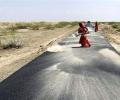
Between April and September 2014, the central govt released Rs 13,618 cr to states, against Rs 24,676 cr in the same period last year.
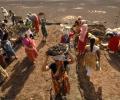
Sources in the Rural Development Ministry said the actual expenditure incurred in 2020-21 will be higher than the allocated funds and it will at least be at par with this year's total estimated expenditure of MGNREGS.
